$JAGX, $3.56. According to PennyGems App stock analysis a large percentage gain in a healthcare stock can invite an easy explanation: investors must be responding to a medical breakthrough. Jaguar Health’s latest corporate action calls for a different starting point. Before drawing a conclusion from the JAGX chart, readers need to understand which securities and distribution rights they are comparing.
There is a legitimate story here about an unusual dividend and investor attention. There is not enough evidence in the supplied image to attribute the entire rally to that dividend, a new drug approval or a change in the company’s underlying value.
The corporate action behind the discussion
Jaguar announced a distribution of Series R convertible preferred stock in October. The company described it as intended to provide dilution protection while it continued evaluating strategic alternatives. [2]
A distribution of securities can attract attention because it changes what eligible investors hold. That makes the event a plausible focus for trading interest. It does not establish that every new buyer receives the distribution or that the business has created additional economic value.
An existing investor and a buyer after the relevant entitlement dates may be evaluating different packages of securities. The headline common-share price alone does not settle that comparison.
What the PennyGems screenshot shows
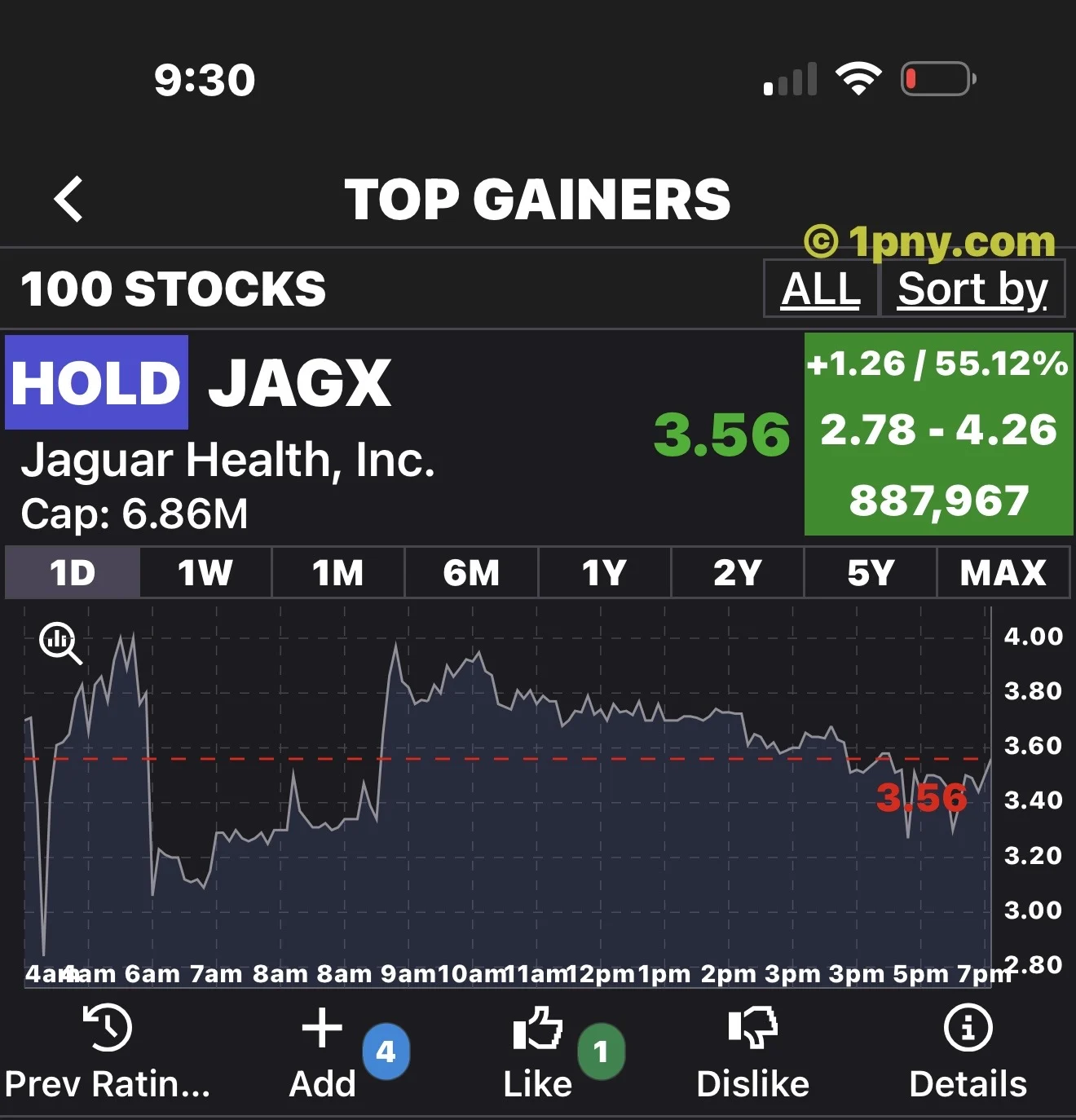
The supplied PennyGems screenshot displays JAGX at 3.56, a gain of 55.12%, and a HOLD rating. The selected one-day chart shows substantial swings rather than a smooth advance. These are captured app figures, not verified regular-session closing returns, a current trading quote or a recommendation adopted by Stock-Advice.com. The full capture date and currency are not identified.
A large percentage is a result to investigate, not a cause. To calculate an investor’s actual return, one would need consistent prices, the relevant securities and a correct treatment of any distribution entitlement.
Dates and conversion terms matter
Nasdaq’s updated notice specifies an October 13 record date, October 15 payment date and October 16 ex-date. The distribution is one Series R preferred share per common share held; each preferred share converts into five common shares on November 2. Nasdaq explicitly says it will not adjust the common-share price on the ex-date. [1]
That last point matters: it would be misleading to call the displayed increase a mechanical exchange price adjustment caused by the dividend. The notice does not establish the reason for the rally. It does establish that distribution terms and price comparison require care.
Readers should confirm eligibility and the handling of any unsettled trades with their broker rather than assume that a common-share purchase automatically includes a separate preferred security. A distribution of more shares also does not function like a cash payment from operating profits.
More securities do not automatically mean more wealth
Imagine dividing the same ownership value among more units. The number of units rises, but the economic value does not rise merely because of that division. This is an analytical illustration, not a calculation of Jaguar’s fair value or a forecast of its post-conversion price.
The meaningful investment questions remain the company’s operating prospects, cash requirements and the claims on value available to common shareholders. A corporate action can alter the capital structure without answering those questions. Strategic alternatives can create possibilities, but they are not a completed transaction or a guaranteed premium.
A stronger explanation avoids a false certainty
The defensible story is that Jaguar’s unusual distribution creates an event for investors to study and may help explain attention around the stock. We cannot establish from the screenshot and these announcements how much of the reported gain came from that interest, positioning or other market factors.
For readers, JAGX is therefore a corporate-action explainer as much as a rally story. Understanding the security, entitlement and comparison period is more useful than inventing a simple bullish cause for a complicated price move.
About PennyGems, the app behind the screenshots
PennyGems supplied the chart screenshots. Available for iPhone [4] and Android [5], it helps readers research low-priced stocks, compare sectors and review buy/sell ratings updated daily. Its iPhone listing advertises over 2,000 stocks under $10. These signals can help build a watchlist and flag weaker candidates; they do not guarantee returns.