$XLAB, $2.14. According to PennyGems App stock analysis an AI company can attract attention with an ambitious presentation. A named customer and a signed equipment-and-services agreement give investors something more tangible to evaluate. That distinction makes Exascale Labs’ latest disclosure a useful starting point for explaining the surge of interest in XLAB.
The investment question is whether this order becomes evidence of a repeatable business. A rally can price in that possibility quickly; delivery, collections and profitability will take longer to establish.
A commercial order behind the AI enthusiasm
In an October 15 SEC report, Exascale disclosed an agreement with Sunon for 12 Nvidia HGX B300 servers containing 96 GPUs, associated equipment, deployment and 36 months of IT operations services. The contract value is $8.208 million, excluding import duties and taxes. [1]
Contemporaneous market reporting on October 16 discussed the agreement alongside a sharp rise in Exascale shares. [2] That makes it a credible news catalyst, although it cannot prove why every investor bought or quantify how much of the move reflected speculation.
Our interpretation is straightforward: a commercial agreement can reduce the distance between an AI infrastructure narrative and actual customer demand. Investors may be willing to reassess the business when they can identify what is being sold and to whom.
What the PennyGems screenshot shows
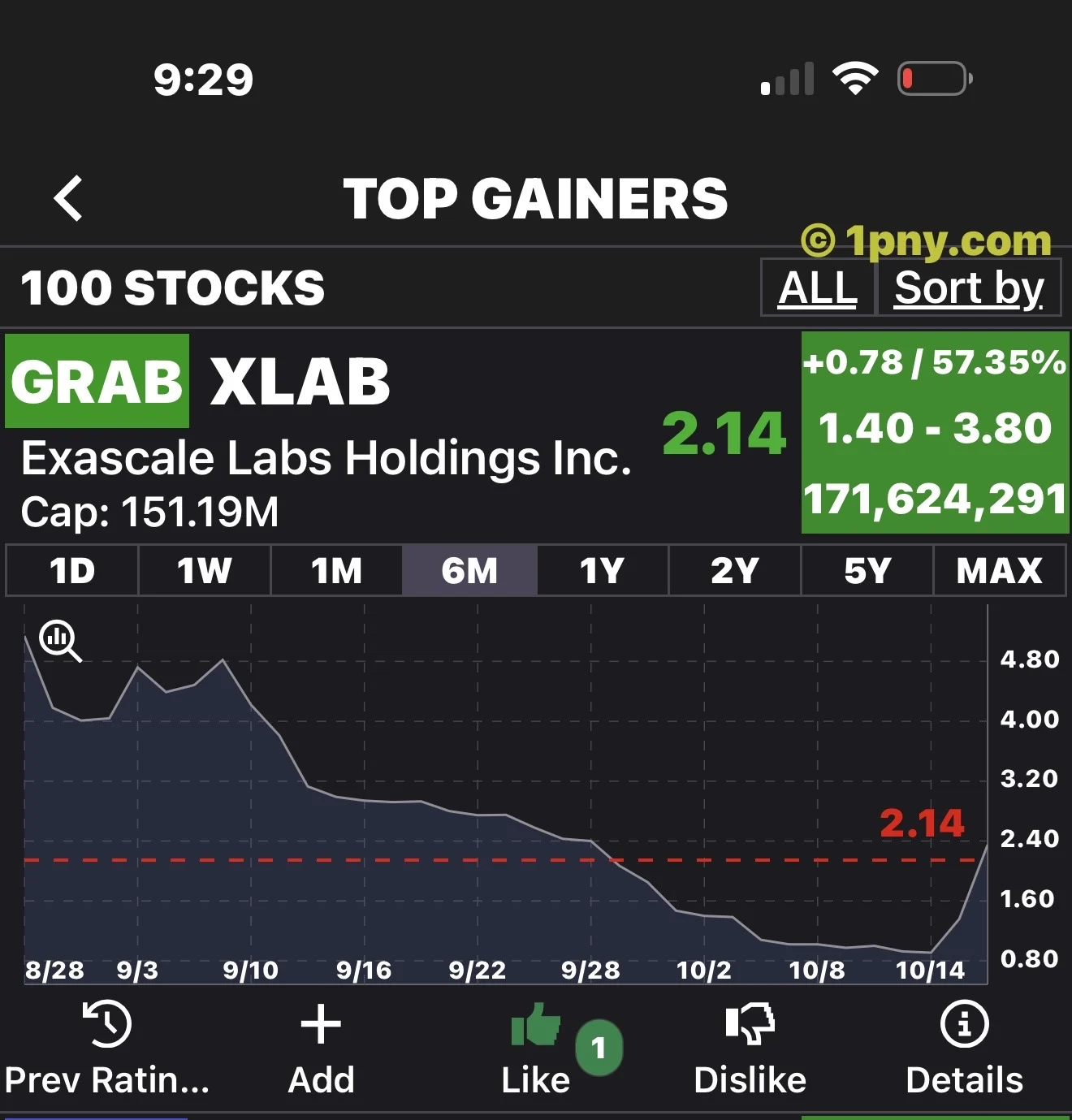
The reader-supplied screenshot displays XLAB at 2.14, a gain of 57.35%, and a GRAB rating. Its longer chart shows a substantial earlier decline followed by a rebound at the right edge. These are the app’s captured figures, not independently verified closing prices or our investment rating. The full capture date, quote currency and session treatment are not established by the image.
A big percentage increase after a deep fall does not necessarily restore the value lost earlier. The useful question is whether the new information changes expected future cash flows enough to justify the price available to a buyer now.
The cash and delivery tests
The filing specifies a 30% down payment following the purchase order and a 70% payment after notice that the equipment is ready for shipment. Delivery is conditional on the deposit, chip-manufacturer approval and required export and import authorizations. [1]
Those terms provide checkpoints, not confirmation that the money has already arrived. An investor should distinguish a signed order from received cash, completed delivery and recognized revenue. Services extending over several years also make it inappropriate to assume that the entire contract becomes immediate sales or profit.
The analytical follow-up is to examine procurement costs, working-capital needs, customer acceptance and the margin retained after fulfillment. A large headline amount can coexist with a modest profit contribution.
What would make the story durable
Evidence of successful fulfillment and additional customers would make the commercial argument stronger. Delays, funding pressure or weak margins would make the market’s initial enthusiasm harder to defend. We would evaluate future orders for their economics rather than simply count announcements.
XLAB offers a clear event-driven story: investors have a real contract to analyze alongside AI demand. The next chapter depends on execution. This explains a plausible catalyst for buying interest; it is not a price target or a prediction that the rally will continue.
About PennyGems, the app behind the screenshots
PennyGems supplied the chart screenshots. Available for iPhone [4] and Android [5], it helps readers research low-priced stocks, compare sectors and review buy/sell ratings updated daily. Its iPhone listing advertises over 2,000 stocks under $10. These signals can help build a watchlist and flag weaker candidates; they do not guarantee returns.